Monday, July 9, 2012

Pictures of continuing plant growth

Hello again to all. Here are some more pictures of continuing plant sale plant growth, and updates on the previous post.

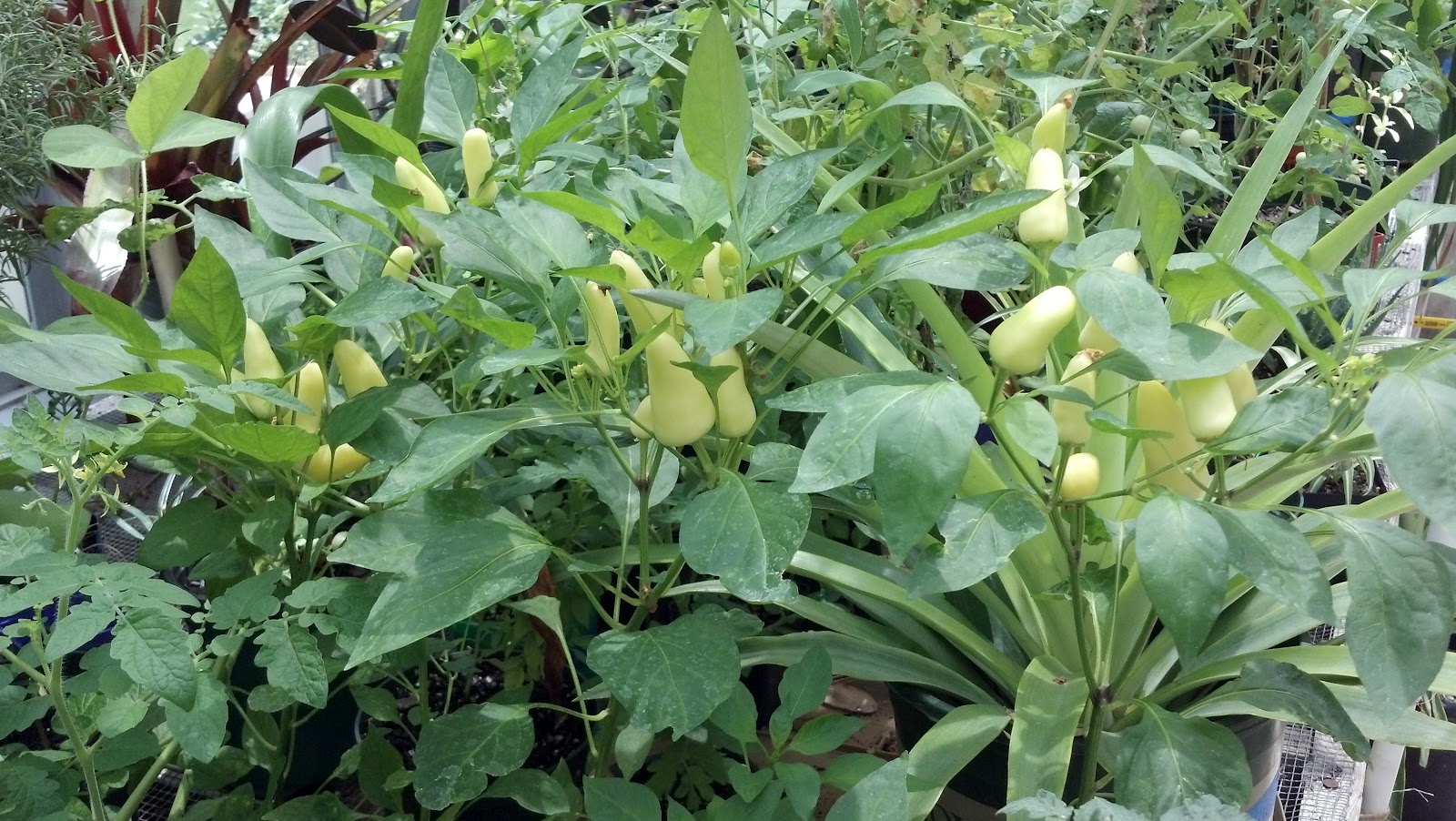
The Sweet'N'Neat tomato fruit has mostly completed ripening, and it was yellow, not red. Definitely sweeter than red, and prettier, too. Here's a picture of the Redskin Pepper plant (actually two planted together), as it continues to fill out quickly. In fact I've lost sight of some of the pepper fruits already.


Can you spot the peppers?


The Spicy Globe basils have filled out really well, forming a bushy mat of yummyness. These were just sprayed with 200 ppm Gibberellic Acid solution a week ago as an experiment.


And it looks like the Dolly Basil is a keeper, producing hand-sized leaves with no overt bitterness on large, bushy plants. The taste is less pungent than that of Genovese Basil, and the leaves are therefore more agreeable to eat raw on a tomato sandwich, for example. 
(Yep that's the same stake as in the earlier picture)

Wednesday, June 27, 2012

Follow-up on sale plant growth

Now that about two months have passed since the last plant sale, we can examine the growth of leftover plants and see how well they grow, and whether they meet or exceed expectations according to their respective plant catalogs. For now, there will just be a text description, with pictures coming in a few days.

Vegetables

Red Robin Tomato and Sweet'N'Neat Tomato are similar enough in appearance that if mislabeled, or not labeled at all, you can't really tell which is which. However, Red Robin did grow worse than Sweet'N'Neat, with less vigor once planted, which unfortunately happened in mid- to late May. The latter tomato does have mediocre flavor, even the yellow variety.


Sweet'N'Neat, probably red variety.  Tomatoes are still forming. 


Sweet Pickle Pepper, as usual, continues to perform well, producing many cute sweet peppers even under hot, outdoor conditions and in small pots.

These plants are in 4" pots.


The one Thai Hot Pepper that I have at home has grown to over 16" in height, double the original estimate. This may be because it grew too tall to begin with. It has begun to produce searing hot peppers prolifically, and is definitely a good plant to consider again for next year. The picture below shows the Thai Hot Pepper as compared to the Redskin Pepper plant.


Now for the small bell peppers. The Yellow Mini Bell pepper that I took home grew slowly and never produced any fruit, until it was demolished by a fungal disease over two days in the beginning of June. The Redskin peppers, of which I had several, began to produce right out of the pot. All the plants produced at least one 3"- 4" pepper before being transplanted. Ideally they should have all been repotted much earlier than June, but one was potted up in April into a 3-gallon pot. After a slow start, it is now thriving, producing several small bells, even in this heat. The plant is barely a foot tall and a foot wide.

Herbs

My one Aristotle Basil has grown into a delightful ball of herb. Its leaves are smaller than any basils I've grown, including Spicy Globe Basil. Medinette Basil, placed into a 2-gallon azalea pot, is growing well and indeed began to flower somewhat later than Dolly Basil. It's gotten to about 1.5 feet tall by 8" wide. Here's another size comparison, along with an individual picture of the Aristotle Basil.


Notice in the comparison picture that the pot on the left is 1.5 gallons, and the one on the right is 2 gallons. Of the two, Aristotle Basil is better for cooking, while the Medinette Basil can be made into enough pesto for 2 - 3 servings of spaghetti.

Five Spicy Globe Basil plants were finally just repotted, into a wide, shallow container, and are growing well despite the heat.

The Curled Parsley all died, except for a few in the greenhouse. Ditto for the lemon basil, unfortunately.

Dolly Basil was planted late, so has already begun to flower. It is a large producer, but is still too small to compare to a mature Genovese Basil bush, which can get to 3.5 feet tall and 1.5 feet wide. Here, two plants are in a 10-gallon pot.


The petunias were not the right color.


Monday, June 4, 2012

What's the most interesting plant in the greenhouse?

Hmm. This one's a toss-up, up to you, the reader. There are three tobacco plants, one of which skyrocketed four feet or so in the last month. The one on the left is in sifted soil to remove dust. This allows for much better drainage and air movement, a larger concern when the plants are watered twice a day for 10 minutes. Less water-logging means happier plants. 


My favorite is the cannabis-looking plant in the middle here, grown by a member. It is actually a type of hibiscus, Hibiscus Cannabinus. Here these two plants have grown to about four feet tall, in a 4-inch container.


Another interesting plant is this spectacular angel's trumpet in the background, with 6-inch flowers that smell most fragrant at night.


Monday, March 26, 2012

Plant Sale Success

Hello again!

The first plant sale was a great success. Thanks to everyone who participated and helped out. The next plant sale is Wednesday, April 11, and Thursday, April 12, and will be announced a week or a few days ahead of time.

A few lessons learned:
1. People always want office plants, and arrowheads and spider plants in 4" and 1/2 gallon pots always sell well. It would be good practice to keep 6-8 small, healthy spider plants on hand for each plant sale, to at least have one office plant available.
2. All mints sell great (MSG). More "classic" mints, like peppermint, spearmint, and chocolate mint, sell better than grapefruit mint.
3. Italian oregano sells well, provided it's in a 1/2 gallon or larger container, and there's a lot of ready-to-be picked herb material.
4. More cactus, even if sold at a loss.
5. Stevia sells well, when bought low and sold high (sorry readers, sometimes we do this).

Most interestingly, some people are more likely to buy herbs and plants from the Horticulture Society when they know that the plants were grown and raised in the greenhouse. (Some can be very adamant about it; apparently UH lavender is a potential niche market).

So, until next time.


Monday, February 6, 2012

List of parts used to insulate the plant cart

Some members have asked for a parts list for the outfitted plant cart, so here it is.

1. A plant cart. Pre-built types like the one used for the greenhouse run from $500 and up. If making it yourself you'll need PVC pipe or some sort of metal framework, a good way to support a fluorescent light fixture or two per shelf, and fluorescent lights and fixtures (full spectrum or daylight lamps).

2. Solar Pool cover. 12x20 will be plenty. This is a great insulator for pools and greenhouses. Assorted threads at Gardenweb will tell the story. If a large pool cover were to be stretched over the entire greenhouse of the Horticulture Society it would probably keep it 20 degrees warmer than outside, virtually all the time.

3. Small Ceramic Space heater. A radiant heater is better because it does not have a fan that can wear out, and the heat is radiated instead of blown. This heater is affordable, keeps the temperature set at 5-degree increments from 60 to 80 F, and is small enough to fit on the bottom of the plant cart.

Heaters usually draw 750 watts at low power and 1500 watts at high power. Since 1500 watts is the capacity of most power outlets, make sure that the heater has its own plug unless you plan to keep it on low.

4. 100 Plastic Ties.

5. 15 feet of Velcro.

6. An extension cord with 12 feet or more of cord. Get one that has space for transformers (for the larger plugs of heat mats).

7. Two clip-on fans to keep air moving inside and distribute the heat to higher portions of the cart. These run between 10 and 20 dollars.

If the heater is not plugged directly into an outlet, use a heavy-duty, outdoor 12 or 14-gauge extension cord (15 feet or so). These can carry 1800 watts versus 1625 for regular 16-gauge cords (which can warm up uncomfortably when the heater is on full power).

Measure the pool cover according to the widths of the metal framework, cut out pieces that are a few inches wider on both sides, and attach them, taking care to overlap pieces to retain heat better.

Leave 6-8 inches of slack on the side that is to be the "door". After attaching it (no ties on top), apply the velcro all the way down. Let it stick for a day - don't use it during that time.

Finally, secure the top overlapping portions with plastic ties.

Tuesday, January 31, 2012

Updates from el Presidente and Co.

Here are some key updates for the week in our Horticulture Society:

Last Meeting:
We went up to our own on-campus Eco-roof to do some weeding in preparation for our replanting project. It turns out it's going to be a much bigger job than anticipated. As of last meeting, we now have a treasurer! And a photographer! (please always feel free to take pictures of your own volition)
We did not get around to posting fliers, so we need two or three people to come out tomorrow, Wednesday Feb 1st at 11:00am, and help us post them around the dorms and other spots on campus. Email us back at this address if you want to help out, or just meet up in the greenhouse tomorrow at 11.


This Friday:

  • Our general meeting will be held at its new official time of FRIDAY, at NOON in the GREENHOUSE. If your schedule does not allow you to make these meetings, please try to attend whatever extra events we have, and we will do our best to keep you updated via email.
  • This Friday our very own Yosef Kerzner will be giving a short talk to help our newbies (and our oldies who still need to learn) get started with the growing season. Make sure to come in and get some great growing tips.
  • We will also discuss plans for continuing the de-weeding of the eco-roof, and just what is being grown for the plant sale.
  • Soon, we'll need to assign someone to plan out how we can grow the UH logo on the eco-roof.
  • Those who are most involved will get their say in what goes in the seven beds on the roof this semester.

Up Coming Events:

  • As always, please let us know if you come across an opportunity or an idea for an event or field trip.
  • We are having a flier Posting Day this Wednesday, February 1st, at 11:00am. Come meet up in the greenhouse at that time to help us plaster our name on all the public posting boards.
  • Dues are $10 and are due to Rachel Gamblin by February 10th.
  • Sometime as February comes to a close, we'll be going on field trip to HCC's World Famous Greenhouse to find out what they're up to and what we can learn from them. This will likely be happening February 24th. Once we know for sure, we'll be asking people about car pooling. Go green, people!
  • Our first Plant Sale for the semester will be in the PGH Breezeway on Thursday, March 22nd.
  • Check out our Google Calendar ! If you have a gmail account and would like access to our calendar, please respond to this email saying so.


In other news, nearly all the seeds that were planted last Monday have sprouted, except for pepper seeds. This includes tomatoes, most basils, parsley, and french sorrel. Soaking seeds overnight really does help, reducing germination times by at least half. Next time though, we'll have to experiment with gibberellic acid solutions to really hot-rod the germination and growth of plants.

From here

Wednesday, January 18, 2012

Seeds for plant sales

Hi again.

Seeds have been ordered for the plant sales in (tentatively) March and (definitely) April. Here's a list, with explanations.

Vegetables
 
Red Robin Tomato - This is a small tomato plant that produces 1.25" fruits on plants a foot tall. It does well in 1-2 gallon containers, and even fruits indoors. Its contender was Tiny Tim, which is 15" tall and requires larger containers.

Mini Bell Series (Yellow) - 16" Tall plants stuffed with 2" mini-peppers. As pepper plants go that's quite small.

Sweet Pickle Pepper - A great sweet ornamental pepper that we sold last year. Amazing production of 2"-long peppers, even in one-gallon containers. See this photo:


Thai Hot Pepper - An ornamental hot pepper whose plants grow no larger than 8".

Sweet'n'Neat Tomato (Yellow) - Last year's best cherry tomato variety, producing best when in a 2-gallon container.

Decent flavor for its size.


Redskin pepper - Similar in growth to Mini Bell pepper.

Herbs

Aristotle Basil - A compact basil.

Medinette Basil - Another compact basil that is slow to bolt in the summer. Since people may not know that it is best to pinch out the flowers to promote leaf growth, this attribute of Medinette will be helpful.


Lemon Basil - 2-3 feet tall. Wonderful lemony smell and flavor. Pesto made with even 5% lemon basil (and 95% Genovese) is fantastic.

Spicy Globe Basil - Another compact basil. Great taste. Choosing this one was a bit like rolling dice - there were seven varieties to choose from.

Curled Parsley - We'll see how this goes. Forms small plants suitable mostly for garnishes (and also for ritual uses).

Flowers

Ultra Crimson Star Petunia (How's that for school spirit?):


Promise Phlox - Mix of colors.
The vegetables and flowers will be planted as soon as the seed arrives, hopefully this week. The herbs won't be planted until the end of January or the first few days of February, since they were ordered late. Drop by the greenhouse to see how progress goes with them. 

Until next time.