Hey guys,
I am Mina, your new Webmaster, which means I will be in charge of updating this blog and the Facebook page (if you haven't liked it already, you should go ahead). Don't be afraid to offer suggestions or any new ideas that we could use to improve this blog, the Facebook webpage, or the club in general.
Hope you guys have a great weekend!
-Mina Khan
Webmaster
P.S. Batman is now a part of the Horticulture Society at UH, so you should join too (and tell your friends).

This is the blog for the Horticulture Society at UH.
News and information will go here, and discussions can be carried out in the comments.
Friday, September 14, 2012

Wednesday, September 12, 2012
Working on the Greenroof
I went up to the greenroof on Sunday with a Horticulture Society member, planning to weed and plant bluebonnets on one of the plots. A few bluebonnets had been spotted alive after the drought of 2011, so I decided to go with a monoculture of bluebonnets as a test. Thanks to the College of Architecture providing funds to fix the watering system, we can begin planting different species of plants and giving them water in a timely fashion.

After raking up the dead grasses and throwing the refuse off the roof for later cleanup, there were still many small weed plants that would need to be manually pulled to fully clear the roof.

I would recommend that a hard rake be pulled through the media to loosen the roots, then separate the media from the weeds by running a regular rake back and forth over the mixture until the plant material is on top. This is virtually the only way to guarantee a weed-free environment up there and prevent competition for moisture.
The plot on the northernmost end of the roof is mostly filled by a low-growing succulent weed, which seems to be doing fine. Here's an up-close example:
In what space was left in that plot I scattered seeds from an old Texas Wildflower mix that may or may not germinate.


We wound up not planting the bluebonnet seeds because there are just too many weeds. The watering system was set up to water the northernmost plot about twice a week, which will be readjusted as needed.
Heavy items were hauled up using a metal bucket and rope, which were left on the roof.

After raking up the dead grasses and throwing the refuse off the roof for later cleanup, there were still many small weed plants that would need to be manually pulled to fully clear the roof.

I would recommend that a hard rake be pulled through the media to loosen the roots, then separate the media from the weeds by running a regular rake back and forth over the mixture until the plant material is on top. This is virtually the only way to guarantee a weed-free environment up there and prevent competition for moisture.
The plot on the northernmost end of the roof is mostly filled by a low-growing succulent weed, which seems to be doing fine. Here's an up-close example:
 |
| ID, anyone? |
Here's a view of the greenroof proper, and a picture of the cleared plot:


We wound up not planting the bluebonnet seeds because there are just too many weeds. The watering system was set up to water the northernmost plot about twice a week, which will be readjusted as needed.
Heavy items were hauled up using a metal bucket and rope, which were left on the roof.
Monday, August 27, 2012
Updates from the greenhouse (and basil!)
Hello again. Here are a few pictures from the greenhouse, along with a comparison of basil growth over the month of August.
 |
| Gigantic sugarcane |
 |
| Buena Creek Aloe Vera |

The above picture is of a pot of "Mexican Sedum", purchased in February of last year to determine how well it will stand hot and humid conditions in the greenhouse. It's grown slowly but has survived and seems to be doing well. Each leaf of this succulent can be plucked off and placed in soil, and it will grow into a new plant. This would be a great candidate for the green roof.
 |
| Another pot of "Redskin Pepper" |


The basil produced the most scintillating pesto ever, turning the parmesan more cheesy, the pine nuts more like peanut butter, and the garlic more intense. Compared to the pesto made from Dolly Basil it was gone much faster. There's still a bunch left, if anyone needs some (just email uhgreenhouse@gmail.com and ask for Yosef's basil).
Horticulture Society Membership Form Fall 2012
Please fill out the HS@UH Membership Form .
(posted for the Fall 2012 semester, but is applicable for all semesters)
Monday, August 20, 2012
New Plants for the Fall
Hello all. During the summer I started growing some new plants for the Fall Plant Sale, and they are doing great. Here are some pictures to show how much they've grown. Most were started in June or July.
This is a cherimoya seedling about a month old. Cherimoya is a fruit tree originating from South America but is now grown all over the world. I started it from seeds that a friend gave to me. Various sources told me that you should place the seeds in water before planting and that any floaters are 'duds', and every seed I wanted to plant floated. Fortunately, three of those four floaters were not duds and are doing just fine.


This is a cherimoya seedling about a month old. Cherimoya is a fruit tree originating from South America but is now grown all over the world. I started it from seeds that a friend gave to me. Various sources told me that you should place the seeds in water before planting and that any floaters are 'duds', and every seed I wanted to plant floated. Fortunately, three of those four floaters were not duds and are doing just fine.

Only two leaves for now.
Stevia is growing a bit slowly, and I actually haven't seen any new growth in a while. They're not the easiest herb to grow from seed, though, so I think it will just take some time for it to really get going.

One of the many Thai basil plants I have. They are also growing very slowly now, though if you go close you can smell their fresh fragrances.

I started this Christmas cactus from a cutting I took from one of the original Christmas cacti in the greenhouse. All you need to do is take a cutting with 3-5 segments, bury one of the segments below the soil line, and keep the soil moist but not too waterlogged. After about 2-4 weeks, the cutting showed signs of new growth, so I know that it has begun rooting.

Note the red growth buds.
Monday, July 9, 2012
Pictures of continuing plant growth
Hello again to all. Here are some more pictures of continuing plant sale plant growth, and updates on the previous post.
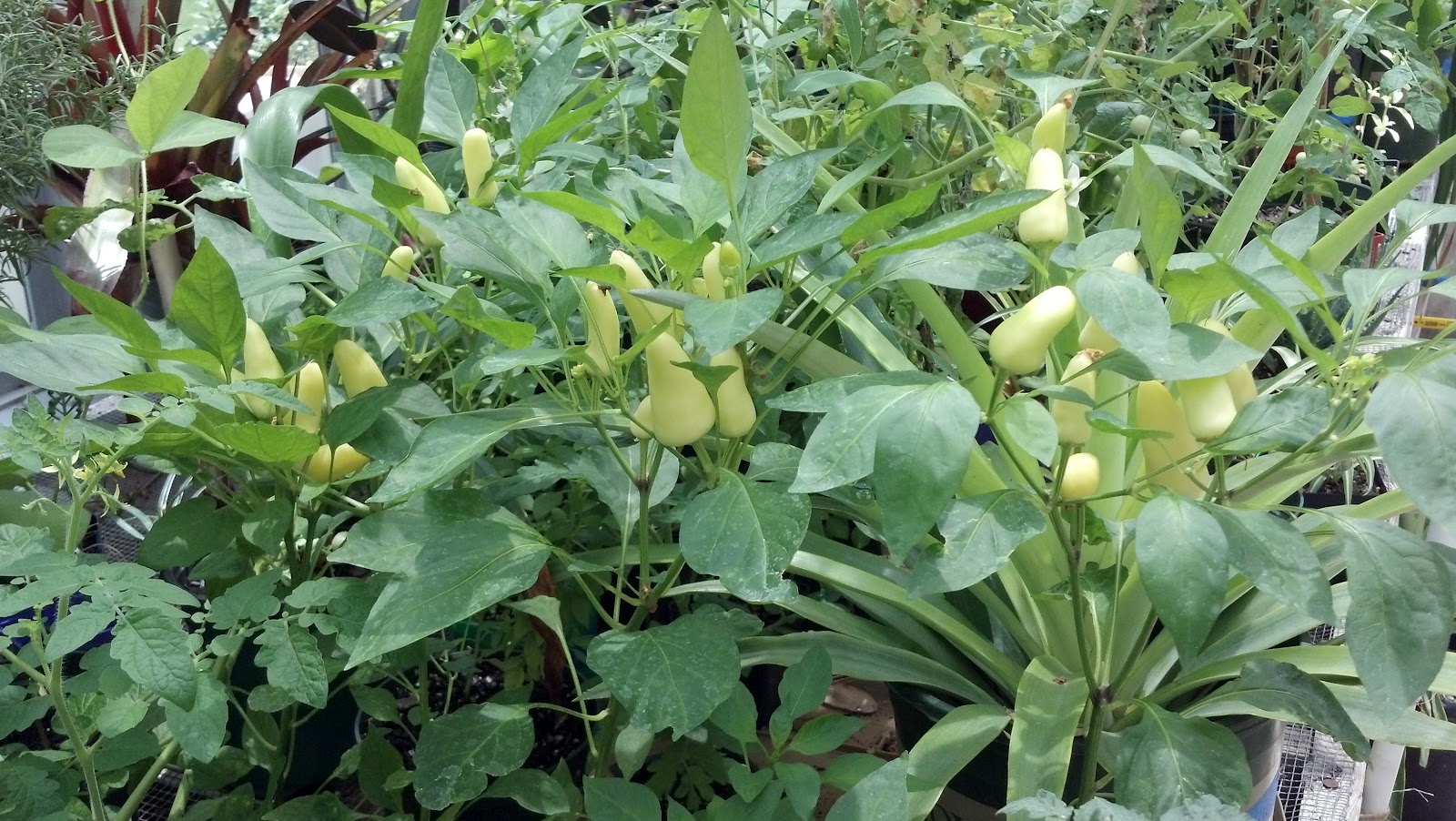
The Sweet'N'Neat tomato fruit has mostly completed ripening, and it was yellow, not red. Definitely sweeter than red, and prettier, too. Here's a picture of the Redskin Pepper plant (actually two planted together), as it continues to fill out quickly. In fact I've lost sight of some of the pepper fruits already.


The Sweet'N'Neat tomato fruit has mostly completed ripening, and it was yellow, not red. Definitely sweeter than red, and prettier, too. Here's a picture of the Redskin Pepper plant (actually two planted together), as it continues to fill out quickly. In fact I've lost sight of some of the pepper fruits already.

Can you spot the peppers?

The Spicy Globe basils have filled out really well, forming a bushy mat of yummyness. These were just sprayed with 200 ppm Gibberellic Acid solution a week ago as an experiment.

And it looks like the Dolly Basil is a keeper, producing hand-sized leaves with no overt bitterness on large, bushy plants. The taste is less pungent than that of Genovese Basil, and the leaves are therefore more agreeable to eat raw on a tomato sandwich, for example.
(Yep that's the same stake as in the earlier picture)
Wednesday, June 27, 2012
Follow-up on sale plant growth
Now that about two months have passed since the last plant sale, we can examine the growth of leftover plants and see how well they grow, and whether they meet or exceed expectations according to their respective plant catalogs. For now, there will just be a text description, with pictures coming in a few days.
Red Robin Tomato and Sweet'N'Neat Tomato are similar enough in appearance that if mislabeled, or not labeled at all, you can't really tell which is which. However, Red Robin did grow worse than Sweet'N'Neat, with less vigor once planted, which unfortunately happened in mid- to late May. The latter tomato does have mediocre flavor, even the yellow variety.
Sweet Pickle Pepper, as usual, continues to perform well, producing many cute sweet peppers even under hot, outdoor conditions and in small pots.
The one Thai Hot Pepper that I have at home has grown to over 16" in height, double the original estimate. This may be because it grew too tall to begin with. It has begun to produce searing hot peppers prolifically, and is definitely a good plant to consider again for next year. The picture below shows the Thai Hot Pepper as compared to the Redskin Pepper plant.

Now for the small bell peppers. The Yellow Mini Bell pepper that I took home grew slowly and never produced any fruit, until it was demolished by a fungal disease over two days in the beginning of June. The Redskin peppers, of which I had several, began to produce right out of the pot. All the plants produced at least one 3"- 4" pepper before being transplanted. Ideally they should have all been repotted much earlier than June, but one was potted up in April into a 3-gallon pot. After a slow start, it is now thriving, producing several small bells, even in this heat. The plant is barely a foot tall and a foot wide.

Notice in the comparison picture that the pot on the left is 1.5 gallons, and the one on the right is 2 gallons. Of the two, Aristotle Basil is better for cooking, while the Medinette Basil can be made into enough pesto for 2 - 3 servings of spaghetti.
Five Spicy Globe Basil plants were finally just repotted, into a wide, shallow container, and are growing well despite the heat.

Vegetables
Red Robin Tomato and Sweet'N'Neat Tomato are similar enough in appearance that if mislabeled, or not labeled at all, you can't really tell which is which. However, Red Robin did grow worse than Sweet'N'Neat, with less vigor once planted, which unfortunately happened in mid- to late May. The latter tomato does have mediocre flavor, even the yellow variety.
 |
| Sweet'N'Neat, probably red variety. Tomatoes are still forming. |
Sweet Pickle Pepper, as usual, continues to perform well, producing many cute sweet peppers even under hot, outdoor conditions and in small pots.
 |
| These plants are in 4" pots. |
The one Thai Hot Pepper that I have at home has grown to over 16" in height, double the original estimate. This may be because it grew too tall to begin with. It has begun to produce searing hot peppers prolifically, and is definitely a good plant to consider again for next year. The picture below shows the Thai Hot Pepper as compared to the Redskin Pepper plant.

Now for the small bell peppers. The Yellow Mini Bell pepper that I took home grew slowly and never produced any fruit, until it was demolished by a fungal disease over two days in the beginning of June. The Redskin peppers, of which I had several, began to produce right out of the pot. All the plants produced at least one 3"- 4" pepper before being transplanted. Ideally they should have all been repotted much earlier than June, but one was potted up in April into a 3-gallon pot. After a slow start, it is now thriving, producing several small bells, even in this heat. The plant is barely a foot tall and a foot wide.
Herbs
My one Aristotle Basil has grown into a delightful ball of herb. Its leaves are smaller than any basils I've grown, including Spicy Globe Basil. Medinette Basil, placed into a 2-gallon azalea pot, is growing well and indeed began to flower somewhat later than Dolly Basil. It's gotten to about 1.5 feet tall by 8" wide. Here's another size comparison, along with an individual picture of the Aristotle Basil.


Notice in the comparison picture that the pot on the left is 1.5 gallons, and the one on the right is 2 gallons. Of the two, Aristotle Basil is better for cooking, while the Medinette Basil can be made into enough pesto for 2 - 3 servings of spaghetti.
Five Spicy Globe Basil plants were finally just repotted, into a wide, shallow container, and are growing well despite the heat.
The Curled Parsley all died, except for a few in the greenhouse. Ditto for the lemon basil, unfortunately.
Dolly Basil was planted late, so has already begun to flower. It is a large producer, but is still too small to compare to a mature Genovese Basil bush, which can get to 3.5 feet tall and 1.5 feet wide. Here, two plants are in a 10-gallon pot.

 |
| The petunias were not the right color. |
Subscribe to:
Posts (Atom)