Monday, January 2, 2012

Insulating the plant cart

Hello again.

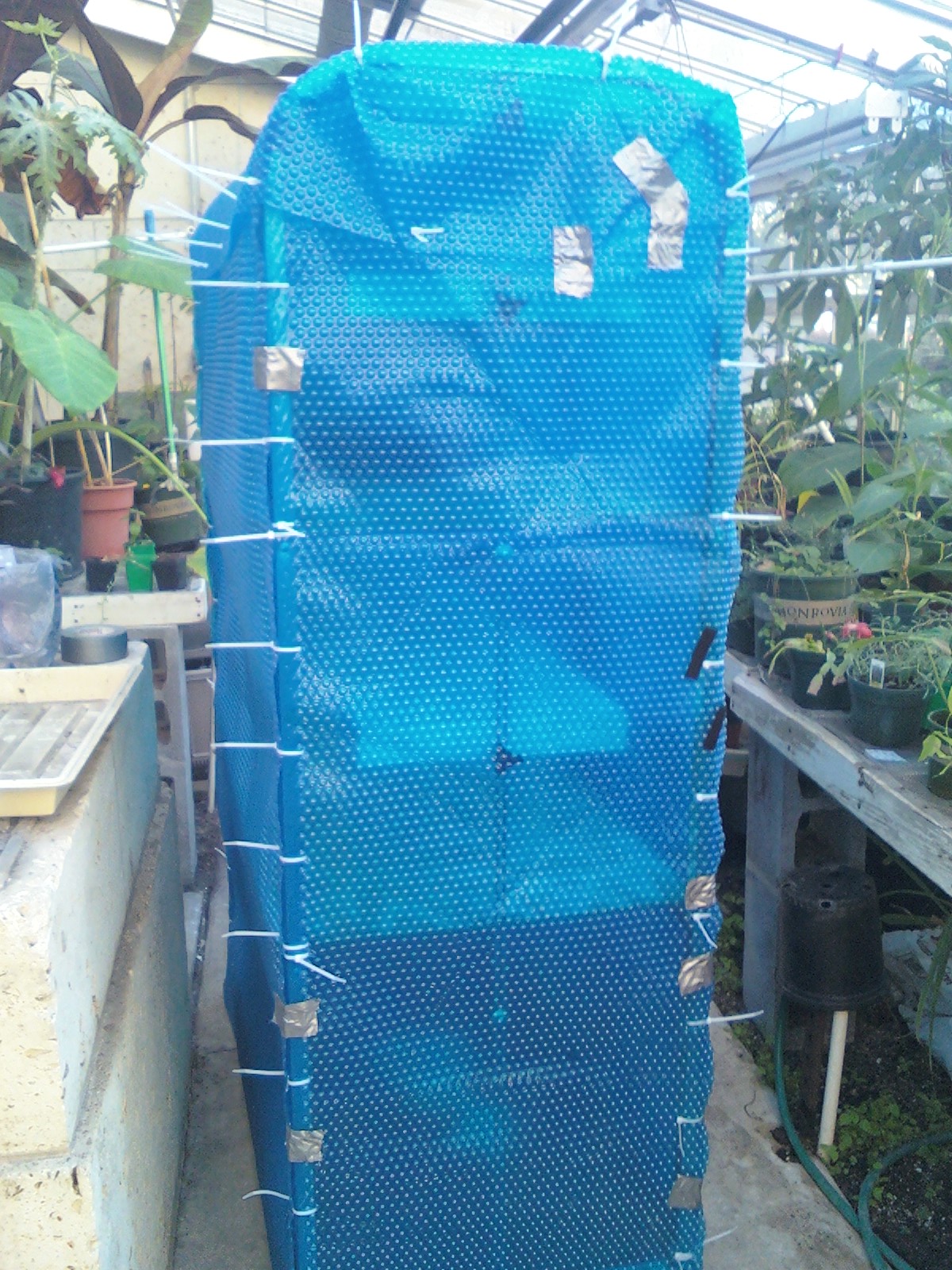
The plant cart has now been insulated with solar pool cover. After some deliberation, and a desire to retain the extremely well-made table seen to the left of the picture (with the watering can on top), I decided to simply attach the pool cover in pieces to the metal framework of the cart.

The table has lasted for 40 years because it is solidly made, with large bolts securing braces near each leg. The original plan called for cutting it down the middle and reconnecting two much-shortened pieces to retain at least some storage and provide more space for the PVC framework.


Six pieces were cut out (and re-cut because of mistakes) from the roll of pool cover and plastic ties were used to secure them to the framework in certain spots. Once all the pieces had been initially attached they were secured more fully, and to each other, to provide better insulation.


One side became the door by leaving slack space and sticking on strips of velcro so that two halves could overlap.


A power strip with an extra-long cord was purchased for electrical equipment, and placed inside the enclosed cart, on the bottom level. It is on a power outlet separate from the heater, which is plugged into a 14-gauge, outdoor power cord (1875W) on its own outlet. The heater is also on the bottom level, and two fans blow air around inside.


The completed set-up has wheels, so it can be rolled out of this "crawl"-space for maintenance. However, it remains crowded, and I wonder how it will be to have a full rack of plants sitting on the top of a fluorescent light fixture. Perhaps they will go to the bottom. Much fun awaits.


Tuesday, December 20, 2011

Seed-Setup Mini-Greenhouse

We've had the use of a plant growth cart like this one for a year now. We opted to lay boards on the rungs and put trays and heating mats on them. The cart's been kept in the science building prep lab up till now, when the entire department moved to the Science Teaching Laboratory. Since there is virtually no space allocated to the plant cart, it's been moved into the greenhouse and things have gotten pleasantly cramped. Since it's too cold in the greenhouse to grow or start seedlings, even with heat mats, I've decided to build a mini greenhouse around the cart.


To do this, solar pool cover will be cut into pieces and tied either to a PVC framework around the cart, or directly to the metal rungs. This cover is usually meant to conserve pool heat, but has been found to keep greenhouses warmer by 20-50 degrees during winter (see this discussion). It's essentially bubble wrap, except a lot sturdier.


A heater was purchased, and it will be connected via an outdoor-rated power cable, preferably one of those heavy-duty 14- or 12-gauge ones, with a rating of 1800 watts (since the heater draws 1500 watts on high). It will be placed below the lowest shelf, or attached to the side, and hopefully keep the temperature inside at 80-85 degrees. Given that the inside volume is about 60 cubic feet, that shouldn't be a problem.

This will be a great help for starting seeds in early January so that we can have decent 4"-sized plants for the spring plant sales.

Stay tuned!
-Yosef

Sunday, September 11, 2011

Plant Sale This Wednesday!

Wednesday, September the 14th, the Horticulture Society at UH will be having a plant sale in the PGH breezeway. It has been a tough summer for our chlorophylled friends, so we will be having a ONE DAY ONLY SALE. (of course, we'll have another sale, later in the semester)

Species available include:
Spider plants
Oyster plants
Shrimp plants (seeing a pattern here?)
Baby pomegranate trees
...and more!

We'll be in the PGH breezeway from 10:00am to 3:00pm. That's WEDNESDAY, folks. September 14th.

Hope to see you there!

Wednesday, June 2, 2010

Snow-fall in summer?

This past Memorial Day, I came in to water the plants and in general see how they were faring. Lo and behold, I discovered that the new fan that had just been purchased from Wal-Mart (of nearly the same make as the one that went kaput a few months back) had toppled backward, almost as if it had been pushed, hit the lid of the trashcan-full of perlite, and went in, with obvious results. It must've been spectacular. By Monday, nearly 25 gallons of perlite had been blown out of the can.

What fun!

What the fan fell off of
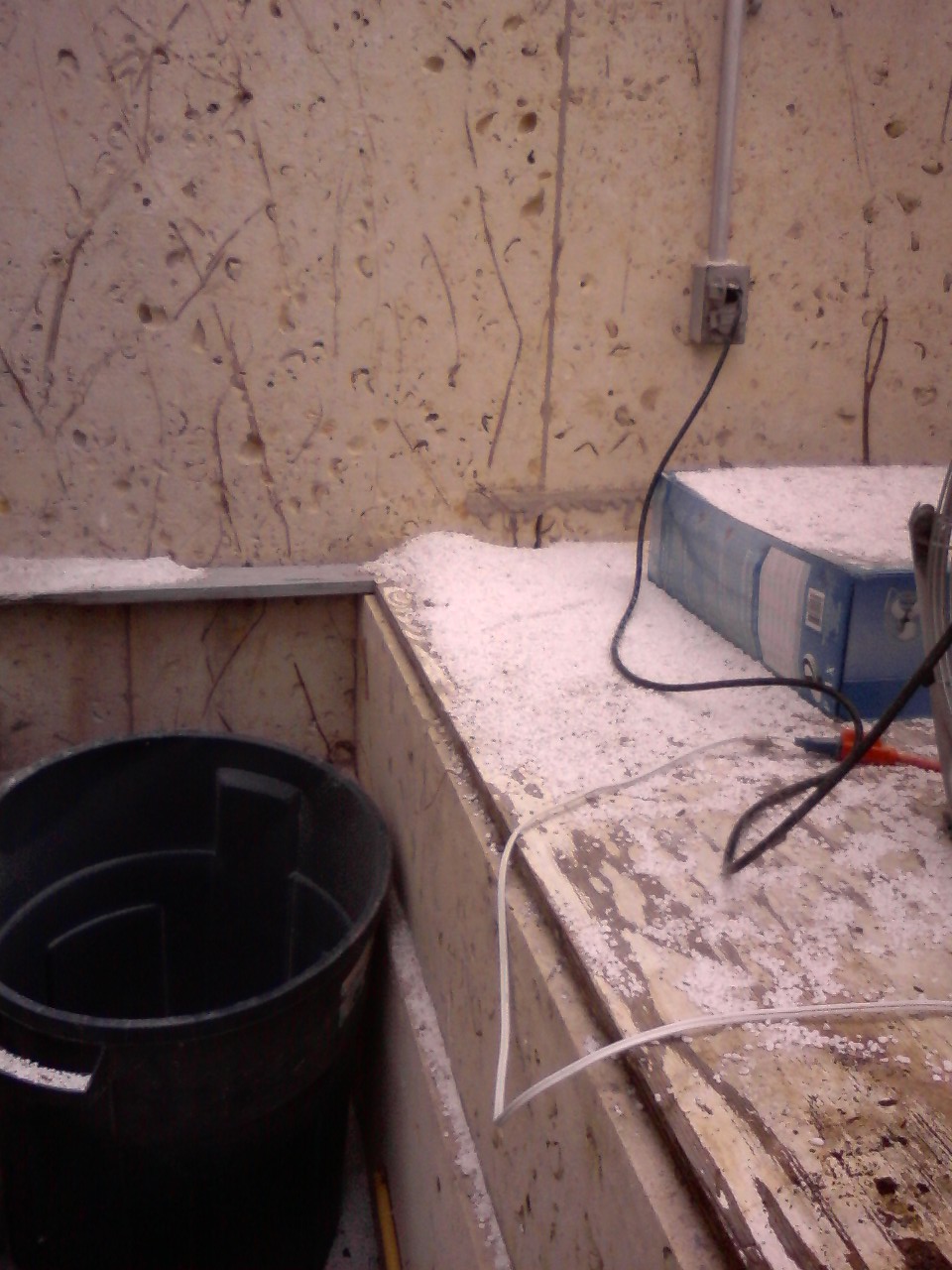
I admit, the fan was placed unsturdily, yet how did the fan fall back so far?

Four feet, maybe?

The heavier particles didn't go far, but the dust was a different matter. I found it under the shade cloth outside and dusting the stems of the tomatoes on the other side. Cleaning the mess was just so much fun, and don't be surprised to find white dust around the greenhouse.

Perlite dust on the roof
Perlite dust on the tomatoes

This, too, is for the best. The remaining perlite is now much less dusty.

Welcome back

Well, it's been nearly a year since the last post here. Hopefully posts will become more frequent.

Thursday, July 9, 2009

Update in our hot summer

Hello all,

So July is here and temperatures in the greenhouse are soaring, to 110 degrees recently, probably 115 or higher with the humidity. And this isn't the end. However, Dr. Pattison has generously donated light-meter measurements that a student of hers will be making twice weekly by stepping into the greenhouse and measuring the light intensity (lux). This will help to create a record, over time, of how much light comes into the greenhouse, and, more importantly, how much shade we need.

Speaking of shade, I'm looking into buying a large roll of aluminet, probably 50% light blocking. Aluminet has the advantage of diffusing light and retaining it much less than simple black shade cloth. This property, however, makes it at least 1/3 more expensive than the usual cloth. Nevertheless, aluminet it will stay.

Recently, I visited AAA Texas Hydroponics & Organics(Street view here). It's a great store, and Chris, the manager, know tons about greenhouses. He recommended moving the entire volume of air in the greenhouse once a minute, shuttling it in and out. Without the movement, the heat and humidity are too much for most plants, just as we are experiencing right now in our own greenhouse. His fan costs $400, but he told me to get a large exhaust-type fan, from farmtek.com (great site). He also identified a fungus afflicting our eggplants just by looking at a leaf, and sold me exactly what would solve the problem, namely, SP-90 wetting agent at 5ml/gallon. Overall, definitely a place to go to if you need urgent troubleshooting or for any greenhouse and hydroponics needs.

That's all for now, so be well. Remember, if you are in the greenhouse, spray the thermometer of the large MODINE heater/cooler with cold tap water for a bit so that it turns on. In addition, drink lots of water (I don't want to be liable for your heat stroke). There are bottles of water under the heater.

Monday, May 25, 2009

Summer Work in the greenhouse

Well, it's been a while since I last posted, probably because of the low activity in the group. Changes are afoot for next year, including a membership fee change and an organization name change. In addition, we will be at several freshman orientations this summer, hopefully, to introduce people to the group. (As an aside, this group is unique because it's probaby the only one on campus that is most active during summer, and winds down in the fall.) Anyone who is interested in joining during the summer semester (if that's possible), can send us a message on Facebook or by email.

On the growing note, it's an exciting time. As the temperatures continue to rise, it's becoming too warm for tomatoes, so warm weather plants will be potted, like eggplants and zinnias. We are always on the lookout for tropicals that can be acquired for the greenhouse. The Venus flytrap is doing well and is even flowering. Look for red zinnias come July, as well as other drought- and heat-tolerant plants. I recently purchased a great fan for the greenhouse, which sounds like an airplane propellar and has rubber "feet" to keep it from moving backwards. It REALLY cools down the greenhouse, so much that within a week some tomato plants set more fruit, even as it got hotter. I'm thinking of adding another fan and rigging up some type of makeshift evaporative system.

In addition, I'd like part of membership in the group to be about learning. Part of what happens in the greenhouse (maybe even most of it) involves experimentation, as most members have never had experience in a greenhouse environment. In order to be successful and have fun, it is necessary to learn as much as possible about greenhouse growing. To this end, I recommend some of the books in our library, whose ISBN numbers and names I will post below. They are located in the basement of the Anderson library. To get them, ask the librarians below for them, as they are in a no-access section (with the awesome moving shelves). While this is not required, I strongly recommend everyone to read some books, since the benefits are self-evident.

I look forward to seeing some more people in the group in Fall 2009 and this summer. If you have any suggestions, email them to me.

Books:

ISBN - 0813431700 - Introduction to Horticulture
ISBN - 0809425629 - Greenhouse Gardening

Greenhouse - Place of Magic - Potter

These are just some possible books - there's a shelf more.