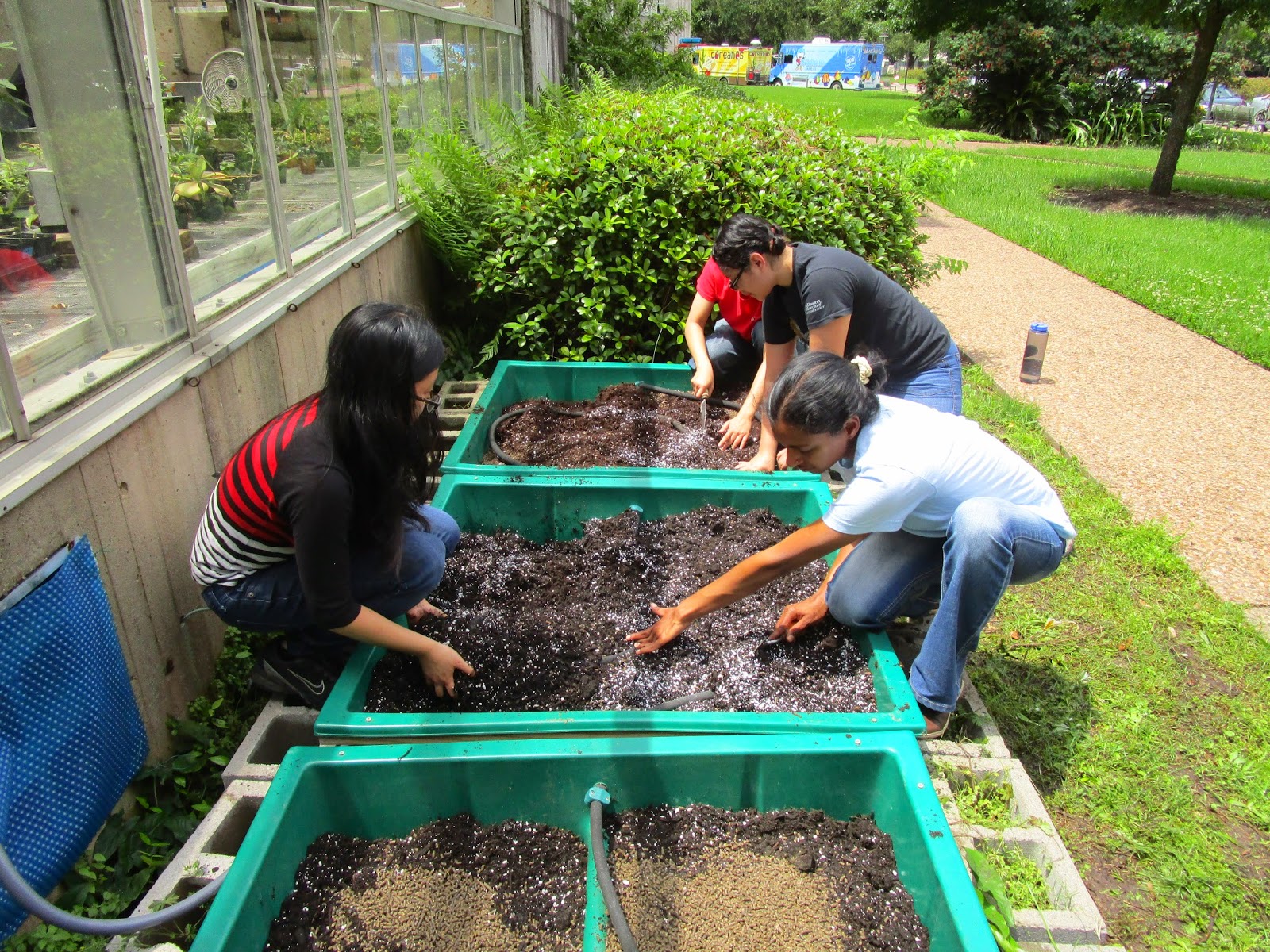
We received a donation of three gro pods from Joe Meppelink of the College of Architecture here at UH, and we recently won a mini grant to fund the set-up of those pods! At our last general meeting, we set up the shade cloth and the gro pods, filling them with garden soil, perlite, and Microlife fertilizer.
Later, we added in a few plants. There are three chrysanthemums, a mini rose, thyme, rosemary, lavender, and oregano! We'll slowly add in more plants like mint, gazanias, and bluebonnets.
Wednesday, May 13, 2015
Saturday, May 9, 2015
Sealing the greenhouse
After UH Plant Ops removed the defunct swamp coolers in front of the greenhouse, it left two large holes in the greenhouse where the coolers once connected. Until recently, I simply covered the holes with pool wrap (the blue bubblewrap-like material), but I noticed that cats (and probably other small animals) were able to enter and exit from the holes despite the covering.
So, in preparation of our gro pods and to stop this problem, I filled and plugged the holes. First, I added in four cinderblocks (18''x6''x6'' each) into each hole, stacked 2x2 blocks.
Then, I put PVC pipe through one of the cinderblocks and ran a hose through the PVC.
To fill the hole, I used big gap expanding foam sealant. I had to go back to Home Depot to purchase a second can because one wasn't enough. Of course, use adequate protection, since the foam is sticky and irritating.
Once all the big gaps were sealed, I added steel wool (#12) into the holes of the cinderblocks to prevent any rodents or pests from getting through. I decided to leave the pool wrap on, since it looks better than the yellow foam sealant.
So, in preparation of our gro pods and to stop this problem, I filled and plugged the holes. First, I added in four cinderblocks (18''x6''x6'' each) into each hole, stacked 2x2 blocks.
Then, I put PVC pipe through one of the cinderblocks and ran a hose through the PVC.
To fill the hole, I used big gap expanding foam sealant. I had to go back to Home Depot to purchase a second can because one wasn't enough. Of course, use adequate protection, since the foam is sticky and irritating.
Once all the big gaps were sealed, I added steel wool (#12) into the holes of the cinderblocks to prevent any rodents or pests from getting through. I decided to leave the pool wrap on, since it looks better than the yellow foam sealant.
Thursday, May 7, 2015
Instagram!
Hey folks. Sorry there haven't been any posts this semester - rather busy for all of the officers. Some good news - we now officially have an Instagram! Follow us at #horticulturesociety.
Monday, January 19, 2015
New succulents for Spring 2015
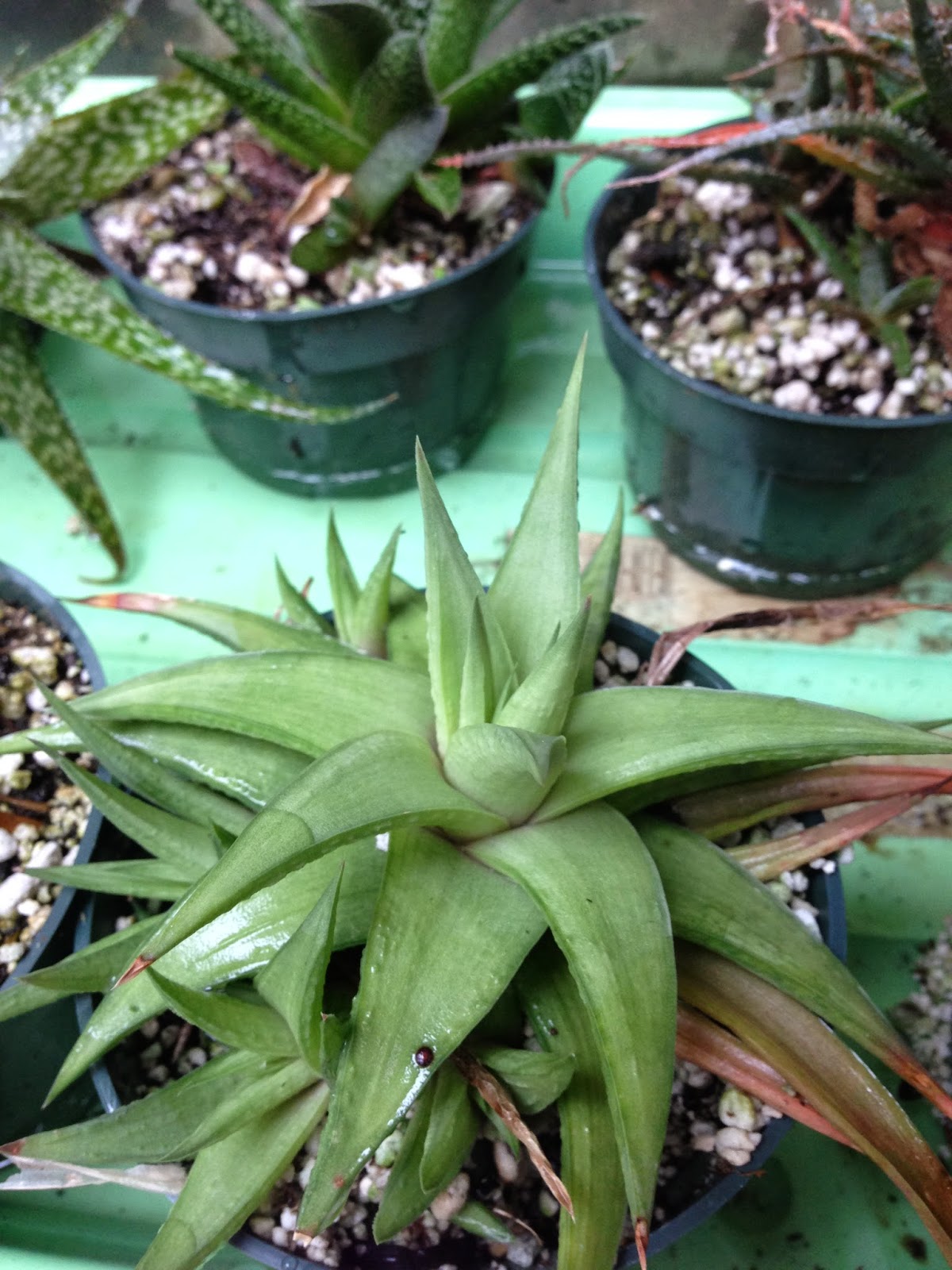
One of my (Chris's) goals for THS was to increase the variety of plants in the greenhouse and offered at plant sales. While we've had mother plants for herbs since our organization began, there wasn't much variety in our succulents until not too long ago. People love succulents because they are (supposedly) all easy to care for and "cute". Here are a few of the new succulents I picked up over the winter break that will hopefully appear at our sales this spring. Since the vendor didn't label any of them, the names might not be 100% accurate, but I based them off of the vendor's website.
| Aloe vera "Cynthia Giddy" |
| Aloe asterious |
| Aloe deltoideodanta v candicans |
| Faucaria tuberculosa |
| Gasteria hybrid |
| Haworthia coarctata |
| Haworthia reinwardtii |
| Aloe hybrid |
| Aloe hybrid |
| Aloe/Dyckia hybrid? |
| Aloe hybrid |
| Mammillaria prolifera (Texas Nipple Cactus) |
| Sansevieria ballyi |
Wednesday, December 31, 2014
Then and Now
From its humble beginnings in September of 2008, The Horticulture Society (THS) has come a long way, increasing its presence and activity on campus and expanding its membership base. Six years later, the club is stronger than ever before, with a much larger variety of plants and members from all colleges on campus.
In the second semester since our founding, the greenhouse was pretty bare, with few plants or supplies.
| January 28, 2009 |
Those empty growing tables seem hardly recognizable now. Thanks to the efforts and dedication of the club's members, we were able to fill the greenhouse with over a hundred plants and bring the club to prominence.
| December 30, 2014 |
Sunday, December 28, 2014
Annual Green Roof Maintenance
This winter, as with every year, we went up to our very own green roof on the Burdette Keeland Jr. Center near the College of Architecture and cut back the dead vegetation so that we can plant new seeds for next year. In previous years we have used a weed whacker, but the grass and flowers were too thick, so we had to use pruning shears. Surprisingly, there were also many bluebonnets still blooming out of season, thanks to an unusually warm winter.
Here's a rough comparison of the work we did on Friday, December 12. Since it was in the middle of finals, not many people turned up, but we still cut back over half of the beds. For the most part, we left bluebonnets unscathed but removed other flowers and grasses, cutting down as low as possible with the shears; any lower would have to be done manually.
| Before |
| After |
| We stopped roughly at the ladder |
We returned the next week (December 17) to finish work on the remaining beds. Early next year, we will overseed the beds with bluebonnets and a native Texas mix to ensure plenty of blooms!
Sunday, November 23, 2014
Hilton Hydroponics Field Trip
This past Friday (11/21/14), we visited Dr. Jay Neal's aquaponics and mushroom lab in the UH Hilton College of Hotel and Restaurant Management! Given that we no longer have any hydroponic setups in our greenhouse, seeing such a large system was very exciting and refreshing. For many of our members, it was their first time seeing such a setup; the last time we had seen aquaponics in action was a few years back at the HCC Northwest Campus.
The aquaponics system, based on a larger setup at the HCC Northwest (Katy) Campus, has two main parts - the growing area for fish, and the planting space. Dr. Neal has over 100 tilapia growing in a large tank, and he said he could easily fit more if desired.

The water from the fish tank, which contains waste excreted by the tilapia, is cycled into the water that the plants' roots bathe in. The fish waste contains nitrogenous compounds which serves as a natural fertilizer that the plants can uptake, and in doing so they clean the water, which is returned to the fish tank. The system works very well - the fish and plants help each other grow, and in turn, both can be harvested and eaten or sold.

So far, Dr. Neal has been running the aquaponics system as a proof of concept; he has no current plans to sell any of the produce from the setup. He's also trying out his hand in mushroom gardening, but when we toured his lab, he had only recently inoculated the mushroom spores, so there was no visible growth yet.
Future work could include growing hops or grapes for the beer and wine tasting classes that also occur in the Hilton. For now, we had a great time looking at Dr. Neal's existing setup and learning about aquaponics.
The aquaponics system, based on a larger setup at the HCC Northwest (Katy) Campus, has two main parts - the growing area for fish, and the planting space. Dr. Neal has over 100 tilapia growing in a large tank, and he said he could easily fit more if desired.
The water from the fish tank, which contains waste excreted by the tilapia, is cycled into the water that the plants' roots bathe in. The fish waste contains nitrogenous compounds which serves as a natural fertilizer that the plants can uptake, and in doing so they clean the water, which is returned to the fish tank. The system works very well - the fish and plants help each other grow, and in turn, both can be harvested and eaten or sold.
So far, Dr. Neal has been running the aquaponics system as a proof of concept; he has no current plans to sell any of the produce from the setup. He's also trying out his hand in mushroom gardening, but when we toured his lab, he had only recently inoculated the mushroom spores, so there was no visible growth yet.
Future work could include growing hops or grapes for the beer and wine tasting classes that also occur in the Hilton. For now, we had a great time looking at Dr. Neal's existing setup and learning about aquaponics.
Friday, November 14, 2014
Updates
Lately, we've just been getting ready for winter. I set up the heater, closed all the vents and windows, and took down the shade cloth. This year, there was an unusual cold front that brought subfreezing temperatures to Houston briefly, but it'll be gone quite soon, and we'll be back to regular Houston winters.
In the meantime, we were featured in The Cougar, the university's newspaper! Daniel Perez came to our Friday meeting (11/7/14) and talked to us, asking about what we do and what we enjoy about the organization. Here's the article, scanned, so that you can read it in full.
Sunday, October 12, 2014
Green roof visit
This past weekend, we went up to the green roof for the first time in a few weeks; weather conditions were not favorable until recently. The green roof looked very much like an actual prairie; there were lots of grasses as well as some flowers and other ground cover plants.
Thankfully it didn't rain while we were up there. In late fall or winter (November-January) we will go in and cut back everything and add some fertilizer, and then seed all beds. The native flower mix has worked well in the past, so it will probably be the main mix that we use, in addition to some other flowers.
| Notice the storm clouds in the upper left |
Saturday, September 20, 2014
Carnivorous Plants, revisited
Until this past plant sale (9/18/14), we never sold many carnivorous plants, save for the occasional Venus flytrap. But this time around, I was able to propagate a large number of Nepenthes ventrata (Asian pitcher plant or monkey cups) as well as a few Sarracenia "Cobra's Nest" (North American pitcher plant).
Every single carnivorous plant (CP) I brought for the sale was sold! We will definitely have more for our next sale, and I am working on propagating other species for the spring, such as sundews and Mexican butterworts. In the meantime, I'll take more cuttings of Nepenthes and continue leaf pullings for Venus flytraps.
If you have any questions about how to care for your CPs, I would recommend that you take a look at our care sheet (adapted from the care sheet at the Flytrap Store).
Every single carnivorous plant (CP) I brought for the sale was sold! We will definitely have more for our next sale, and I am working on propagating other species for the spring, such as sundews and Mexican butterworts. In the meantime, I'll take more cuttings of Nepenthes and continue leaf pullings for Venus flytraps.
| Nepenthes ventrata for the Oct 22 sale! |
| Nepenthes ventrata, almost 2 years old |
| S. "Cobra's Nest" |
| A VFT with red coloration |
| Australian sundew |
| Mexican butterwort |
Saturday, September 13, 2014
Scarifying and germinating seeds
To start the fall semester, I decided to purchase some interesting seeds online - dragon tree seeds. The fully grown tree is known for having blood-red resin in its trunk, which has a variety of uses. There are two main species of dragon trees that are harvested for this resin - Dracaena drago and Dracaena cinnabari. I could only find seeds for the former, which is native to the Canary Islands.
Unlike most seeds, dragon tree seeds have a very tough outer shell. This protects the seeds as they pass through birds' digestive tracts in their natural habitat, allowing them to be dispersed in various locations, but it also makes it more difficult for growers to germinate the seed. To break this coat and allow water into the seed, scarification is key. Scarification involves nicking or breaking the outer coat of seeds to speed up the germination process. Usually sandpaper is used, though knives can also work for larger seeds. I found that sandpaper worked fine for these relatively small seeds (~5mm in diameter). Scarification is also useful for other plants with tough seeds, such as bluebonnets.
After scarifying all seeds, I placed them in a cup of water for about three days, changing the water periodically. After this time, you can see a single white root protruding from many of the seeds. This seed should be planted in well-draining soil with this root pointing down and covered with 0.25 inches of soil. I just planted mine, so I have no idea how long it takes to germinate when they have the single root, but most sources indicate 30 days for any growth to appear.
Unlike most seeds, dragon tree seeds have a very tough outer shell. This protects the seeds as they pass through birds' digestive tracts in their natural habitat, allowing them to be dispersed in various locations, but it also makes it more difficult for growers to germinate the seed. To break this coat and allow water into the seed, scarification is key. Scarification involves nicking or breaking the outer coat of seeds to speed up the germination process. Usually sandpaper is used, though knives can also work for larger seeds. I found that sandpaper worked fine for these relatively small seeds (~5mm in diameter). Scarification is also useful for other plants with tough seeds, such as bluebonnets.
| Notice the dark orange outer coat and the exposed white surface of the seed |
Tuesday, June 17, 2014
Help us Help You!
Today is a wonderful day to buy plants!
But before we do that, The Horticulture Society would like for each and every one of you to fill out a survey to help us cater to your wants and needs.
We are planning our best year yet, and we cannot do it without your input! Below is the link to the survey and our email address (just in case you would like to give us more points on how to improve our plant sales and other events).
Email: uhgreenhouse@gmail.com
Tuesday, May 20, 2014
Earth Day Update
We had a blast at this year's UH Earth Day (4/22/14)! Numerous organizations were there, from UH's own Sustainability and Campus Community Garden to the Center for Biological Diversity and Galveston Coastal Prairie Conservation groups. Our organization was fortunate enough to get a nice tent, though it didn't end up raining.
We had a table set up with a board detailing our plants, our volunteer efforts, and most importantly, our work on the green roof. Additionally, we were giving away peat pellets along with herb and vegetable seeds for visitors to take and plant for themselves.
While we ran out of freebies to give away after only an hour, we were still able to reach out to many students and staff who had never heard of us before. Hopefully we'll see them in the fall semester!
We had a table set up with a board detailing our plants, our volunteer efforts, and most importantly, our work on the green roof. Additionally, we were giving away peat pellets along with herb and vegetable seeds for visitors to take and plant for themselves.
| Our webmaster Mel is very excited for Earth Day! |
Saturday, May 10, 2014
New succulents for the fall
I recently went to Home Depot, looking for any new plants that I could add to the greenhouse. Surprisingly, they had a very large variety of succulents offered, many of which were native to South Africa and were never offered there before (to my knowledge). Others were succulents we once had, but the mother plants were sold off or died before propagation.
These are some pretty nifty plants, and hopefully we'll have some for sale this fall; if they aren't big enough by then (I'll be fertilizing throughout summer), you'll be able to buy them in the spring.


These are some pretty nifty plants, and hopefully we'll have some for sale this fall; if they aren't big enough by then (I'll be fertilizing throughout summer), you'll be able to buy them in the spring.
Zebra Plant (Haworthia fasciata). Our original died, but now I know how little water this plant needs.
|
Firestorm sedum (Sedum aldophii "Firestorm"). It's always nice to add more sedum to our collection, and this one has deep red coloration, very fitting for our university.
|
Haworthia venosa v. tessellata. Another cool plant from South Africa.
|
Crassula "Caput Minima". It has unusually soft leaves and a tesselated appearance.
|
Haworthia subspecies. Very tough leaves.
|
Haworthia mirabilis mundula. Another neat Haworthia, with redder coloration.
|
Plush plant (Echeveria harmsii). Similar to the panda plant with its fuzzy leaves, but its growth is more akin to that of a sedum.
|
Two unknown plants from Whole Foods Market (grown in East Texas), most likely Haworthia.
Subscribe to:
Posts (Atom)